I didn't start out wanting a home lab. I wanted to know what was happening behind the button.
When I was learning PHP, EasyPHP gave me a web server, a database and the rest of the setup in one convenient package. It worked. But I wanted to understand how those pieces fit together, and I didn't want to wait for the next EasyPHP release every time I wanted to try a newer version of something.
So naturally, the reasonable solution was to get a whole Linux server.
These notes bring together several things I wrote about my home lab in 2023. The equipment and experiments below describe that time, not necessarily what is running at home today.
How it started
I learned to code by reading online and trying things: HTML and CSS first, then JavaScript, then PHP. I loved PHP. To pay for hardware, I'd find little jobs like mowing lawns, then spend what I earned on computer parts. It was a pretty good trade, as far as I was concerned.
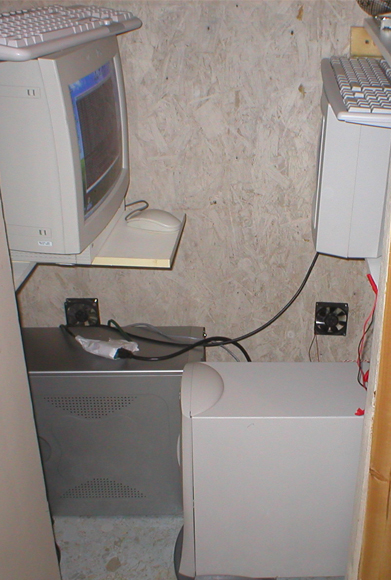
This was my setup at my parents' place in 2006. I had recently added fans. Very serious infrastructure.
The computer on the left ran Windows XP and a Sphere server for an Ultima Online shard called Apocalypse. There was a community of around a hundred players. The one on the right ran Ubuntu Server—my first experience with Linux—and hosted small web projects, including Orkïka, a medieval browser game I wrote in PHP.
At other times I hosted Counter-Strike 1.6 and Wolfenstein: Enemy Territory servers, along with voice services. I didn't create those games or voice applications; I loved having a place to run them and figure out how they worked. One missing character in a configuration file could also turn that place into an opportunity to contemplate the meaning of life.
Running a game world meant more than starting a server process. A later collection of UO-Apocalypse 2 scripts includes separate channels for chatting and trading, a quest involving a missing pickaxe, and capture-the-flag rules for teams and scoring. I don't know that those were the exact scripts on the 2006 machine, or who wrote each one. But they remind me what the computer was there for: giving people things to do together.
Around the same time, I found a community of people learning to make games with PHP. It eventually became JeuWeb, and I helped run it with other people. The game servers, my own browser game and the forum weren't the same project, but they all gave me reasons to keep figuring things out.
Those early experiments were also part of how I got into building software for other people.
Machines with different jobs
Years later, my lab wasn't one server anymore. The question had changed from “can I run this?” to “what happens to everything else when I break it?”
In 2023, I separated the important jobs from the recreational ones. A little fanless Qotom running Proxmox handled the critical side. Its modest CPU was a feature, not a disappointment: I cared about low power and keeping it running on battery longer during an outage.
For experiments, I used a refurbished Lenovo ThinkCentre. It was an inexpensive second-hand office PC, but it gave me a separate place to play with web development, photos and Home Assistant. Virtualization meant I could give different projects their own space without buying a whole computer for each one.
I also had a Windows machine for software that needed Windows or dedicated processing power, and a small QNAP NAS for storage. The NAS wasn't powerful, so I tried to keep its job simple: files, synchronization with Syncthing and backups elsewhere for the important stuff. A NAS is convenient; it isn't a substitute for a backup.
The network in between
The software around those machines was part of the fun. I used pfSense as a router and firewall, the UniFi controller with my access points, and AdGuard for DNS filtering. I had tried OPNsense too, but pfSense did what I needed at the time. The Wi-Fi 6 upgrade was one I had looked forward to, and I wasn't disappointed.
None of that makes the network finished. It just means I had a working arrangement and, inevitably, more things I wanted to try.
The photographs I didn't quite want to leave behind
Google Photos was harder to leave than I wanted it to be. The interface was good, sharing was easy, and the automatic memories were fun. But I had been thinking about having more control over my photos, especially after Google removed the old Drive connection that had let me back them up to my NAS.
In 2023, I exported the library with Google Takeout, put it on the NAS and pointed PhotoPrism at a read-only copy. I set up an off-site backup before considering deleting anything from Google Photos. The first backup took something like a week or two. By the time it finished, I'd moved on to other projects—and I wasn't entirely happy with PhotoPrism's face recognition for my library. The plan to remove older photos from Google hadn't happened.
The export exposed another problem: I had so many almost-identical photos. Tap, tap, tap, just to make sure I got one good shot. Then I'd keep all of them and pay for more storage instead of choosing. That's a kind of debt that doesn't look like debt until you see years of it in one place.
It got me thinking about how easy it is to collect things without spending much time with them. Remember discovering a band through a CD, or finding a game at a friend's house? I still wonder what changes when the next song, photo or game is always one tap away.
A house that can do a few things for itself
Home Assistant was another experiment that kept growing. A Raspberry Pi was expensive and difficult to find locally, and I wasn't sure how much computing power I'd eventually need. I went with a refurbished PC, installed Proxmox, and ran Home Assistant in a virtual machine. The computer could do more than just one thing, which made me happy.
The beginning was intimidating: devices, integrations, protocols, automations, and YAML, which I wasn't used to yet. Then I discovered I liked editing automations in VS Code. There was a UI too, but at the time I was firmly on team YAML.
My favorite was Adaptive Lighting. Lights could adjust their brightness and color temperature through the day, so I didn't have to keep thinking about whether a room was too bright or too warm. A button to open and close the blinds made me feel like I was living in the future. Little things, but I enjoyed them.
Not every experiment was a success. I'd bought Wi-Fi bulbs and plugs that depended on Tuya, and dealing with disconnects, delays and cloud communication was frustrating—especially after spending money on them. I tried localtuya with some devices and gradually moved toward Zigbee. I liked being able to mix devices from different manufacturers, and when I found a device without a converter, I made one and opened a pull request so someone else could use it too.
There was always another idea on the list: better energy information, useful temperature and humidity automations, plant reminders. That's part of the appeal. It's also how “just one more automation” becomes an afternoon.
Cameras, performance and a little caution
I used Blue Iris for camera recording. One thing I noticed was that leaving a camera-group view open could use a surprising amount of CPU. Lowering the group's default frame rate made a noticeable difference on my setup. It was a useful reminder that the cost of a system isn't only the hardware sitting in a corner; it's also what you ask it to do all day.
I organized recordings into separate groups with their own retention rules. I also spent time thinking about how to limit camera exposure rather than simply opening the recorder to the internet. Those choices depend on the network and software versions, so my old notes aren't a ready-made security recipe.
Why keep a lab?
I like owning more of my data, but that's only part of it. I like trying things, understanding why they work, breaking them, and eventually getting them working again. Sometimes the result is a useful service. Sometimes it's a new appreciation for how much work a convenient service was doing for me.
And sometimes it's an entire evening lost to one missing character. Still worth it. Usually.